
Agora Circle
All Resources

Video Series

Personal Finance & Wealth Building

8 videos

Your SIP Looks Perfect On Paper Until You Do This Math

Your SIP Looks Perfect On Paper Until You Do This Math

Picture a disciplined investor doing everything by the book, a 20,000 rupee monthly SIP for 25 years, no leverage, no panic-selling, who still quietly forgoes more than a crore of potential wealth. Not because the market crashed or they stopped investing, but because of a single piece of arithmetic almost nobody runs. The video is careful to say it is not anti-SIP: it credits SIP culture with moving crores of Indians from a fixed-deposit mindset to equity ownership and genuine long-term discipline. The problem it explores sits in the gap between convenience and intellectual laziness, where costs, fund selection, and unexamined assumptions compound silently over decades. It walks through the scenario to show how even textbook-correct behaviour can leave large sums on the table, and why real financial literacy, understanding what you own, what it costs, and how the math actually works, matters as much as the discipline of investing itself. The aim is to push beginners from 'set it and forget it' toward 'set it and understand it'.

Read summary
The ₹6 Cr Strategy Everyone Gets Wrong | How to Get It Right

The ₹6 Cr Strategy Everyone Gets Wrong | How to Get It Right

A normal salaried couple can build six to seven crore in net worth by their mid-thirties, this video argues, without a business, crypto gambling, or a lottery win, and the hero of the system is structure rather than spectacular returns. It walks through a three-engine compounding framework for a young couple each earning a modest salary who decide to control their lifestyle and build capital from day one. The engines are roughly a long-term diversified core compounding at a steady rate, a survival-focused cash buffer, and a smaller trading overlay that lifts blended returns. It then stress-tests the plan against bad scenarios such as a market crash or a trading drawdown to show the structure still holds. The point is that disciplined allocation across complementary engines, not a single lucky bet, is what most Indian couples are never shown and what quietly does the heavy lifting.

Read summary
Marry At 25, Not 30 | The ₹5 Crore Compounding Formula

Marry At 25, Not 30 | The ₹5 Crore Compounding Formula

Framed deliberately as a provocation, this talk argues that a large wedding can be one of the biggest acts of wealth destruction a family commits, because the same sum, compounded over two decades, could have grown many times over. Speaking to a packed university audience, the speaker makes an unconventional case: two earning partners who combine incomes early, keep expenses controlled, and give compounding a decade's head start before their mid-thirties hold a structural advantage. He challenges a marriage-age generation to stop treating tens of lakhs as a one-day expense and to start treating those rupees as seed capital for long-term wealth. It is a perspective piece on priorities and timing rather than a literal instruction about when to marry, using a contrarian frame to make a point about how early decisions and compounding shape the wealth you end up with.

Read summary
Salary Aati Hai, Invest Karte Ho, Phir Bhi Rich Nahi? Yeh Skill Miss Kar Rahe Ho

Salary Aati Hai, Invest Karte Ho, Phir Bhi Rich Nahi? Yeh Skill Miss Kar Rahe Ho

You learn to ride a bike, to drive, to swim, but nobody teaches the one skill that decides your finances: making money actually work. This video introduces what it calls Activation Level 2, pledging existing investments to unlock margin that can fund trading, so the same capital does more than one job. Using a ten-lakh example, it shows how a portfolio can keep compounding through investments while simultaneously providing margin for options and index trading. It draws a clear line between investing, which is passive, and trading, which is active and aims to generate alpha through decisions, and it warns plainly that margin without risk control is a recipe for disaster. The episode is aimed at salaried investors who diligently park money yet wonder why their wealth stalls, suggesting the missing piece is making capital active rather than letting it merely sit.

Read summary
Paisa Invest Nahi, Activate Karo | Capital Allocation for Beginners

Paisa Invest Nahi, Activate Karo | Capital Allocation for Beginners

The familiar advice is to start a SIP, buy mutual funds, and stay long term, but this video argues that capital left sitting in one place, earning a steady return while you ignore its risk, role, and rotation, is not really working. It introduces the idea of 'activation of money', a capital-allocation system that separates passive investors from active allocators. Citing Peter Lynch's remark that people spend more time choosing a house than a stock and then blame the market, it uses a ten-lakh example to show why putting everything in one basket without defining each rupee's job is a mistake. The framework asks you to assign risk, role, and rotation to your capital so it is deliberately deployed rather than parked and forgotten. It is aimed at beginners who follow the standard playbook yet sense their money could be doing more.

Read summary
Your Salary Needs This to Work for You | Compound Reality

Your Salary Needs This to Work for You | Compound Reality

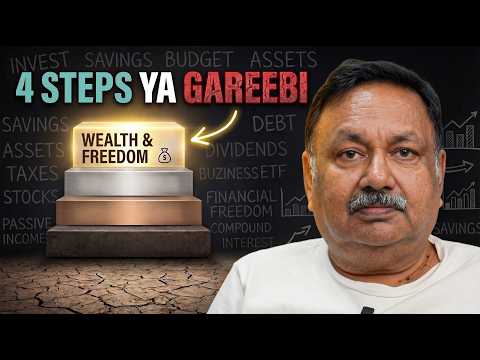
Salaries are decent and SIP inflows are at record highs, yet many salaried Indians stay stuck in the same loop of salary, EMI, expenses, SIP, repeat, with little to show after a decade. This video identifies the leak as treating salary as income to be spent rather than capital to be deployed. It introduces a four-step wealth system, Save, Invest, Activate, Compound, and argues that skipping any one step keeps your money stagnant even as your lifestyle keeps inflating. The 'activate' step is the one most people miss, putting idle capital to deliberate work rather than letting it sit. Presented as part of a series, the episode connects disciplined saving, thoughtful investing, active deployment, and patience into a single chain. The message is that earning well is not the same as building wealth, and that the gap is a system most people never set up.

Read summary
The Regret Calculator: Lump Sum vs SIP in 2026

The Regret Calculator: Lump Sum vs SIP in 2026

Go all in with a lump sum and you may regret it quickly; stick to a SIP and you may regret it slowly; wait for the perfect entry and you quietly miss the whole move. This video frames every crash as producing three kinds of investors, the one who deploys too early and watches prices fall further, the one who dilutes the opportunity by drip-feeding, and the one who waits for a bottom that never announces itself, all of whom end up sharing the same feeling: regret. Its answer is a structured three-layer capital-deployment system that replaces emotion and prediction with a pre-decided framework. Rather than timing the bottom, it spreads deployment in disciplined phases so you stay present in the market while keeping downside managed. The takeaway is that the market reliably recovers but an unplanned portfolio may not, and a simple system beats trying to outguess the low.

Read summary
Generational Wealth Dar Ke Paar Hai | Why Retail Must Think Like Institutions

Generational Wealth Dar Ke Paar Hai | Why Retail Must Think Like Institutions

Someone claims to have lost five crore and then made ten with a holy-grail strategy, now selling it to you cheaply, and this video points out the obvious tell: anyone who genuinely made that would not be selling a course. It dismantles the holy-grail myth that traps retail traders into buying systems never built for their psychology, capital, or risk profile. No indicator predicts the future; indicators only describe probabilities from past patterns, and no single strategy works across every market condition, just as no single cricket shot works against every bowler. What actually makes a profitable trader, it argues, is knowledge, process, risk management, and psychology, and trading is best understood as a one-person startup that takes real effort to build. The broader theme is that retail can adopt the disciplined, probabilistic mindset of institutions instead of chasing shortcuts sold by people profiting from the search.

Read summary