

Agora Circle
All Resources

Video Series

The Correction Playbook

3 videos

You Keep Missing the Dip, Here's Why | The Investor Behaviour Loop Exposed

You Keep Missing the Dip, Here's Why | The Investor Behaviour Loop Exposed

'Let it fall more,' you say on the way down; 'too late now,' you say once it bounces. So when exactly do you buy? This video names the wait-miss-regret loop that traps investors in almost every correction and explains why it repeats. Using a recent Nifty move (a quick drop of about 5% followed by a bounce of roughly 3.5 to 4% in just two sessions) it shows how the 'perfect bottom' is only ever obvious on the left side of the chart; in real time, by the moment you feel confident enough to act, the move has already happened without you. Strong names fall and recover in days, not weeks, which is why waiting for certainty so often means buying back higher. The reframe it offers is simple but hard to live by: the real game is participation, not prediction. Rather than trying to call the exact low, the video argues for a process that keeps you invested through the fear, because corrections tend to reward those who show up over those who wait for a signal that only exists in hindsight.

Read summary

Market Gira? Entry Ka Time Hai | Beginner's Correction Playbook

Market Gira? Entry Ka Time Hai | Beginner's Correction Playbook

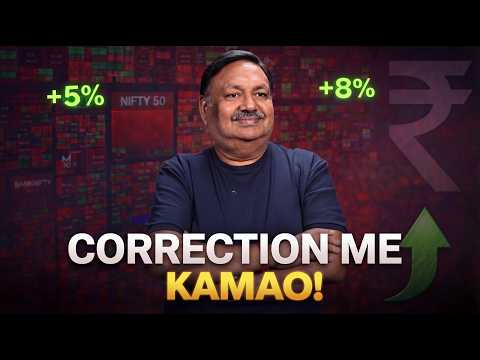
When markets fall and news channels sound the alarm, the standard advice is to stay away. This video makes the opposite, historically grounded case: the biggest wealth has usually been created after corrections, not during booms. It notes that a far larger share of household wealth sits in equities in some developed economies than in India, and that this gap tends to narrow after every crash. Echoing Peter Lynch's observation that more money is lost preparing for corrections than in the corrections themselves, it compares fixed deposits with equities when inflation roughly matches FD returns, leaving real wealth creation near zero. From there it offers a beginner's plan for entering during a correction in a structured, phased way rather than freezing or panicking. The message is that fear, not the correction itself, is what usually costs new investors the most.

Read summary
Why Traders Love Market Corrections | The Edge Nobody Talks About

Why Traders Love Market Corrections | The Edge Nobody Talks About

Every correction brings the same chorus of advice to stay calm and think long term, but this video asks why, if corrections were so dangerous, the largest fortunes in market history were built after them. It argues that a disciplined trader holds a structural edge over a purely passive investor during a crash. It covers stop-loss discipline, position sizing, cash management, and trading volatility, and frames the approach as a three-part method of capital protection, patience, and selective aggression. The distinction it draws is between traders who merely survive a downturn and those who use it to build, the difference being preparation and process rather than prediction. It is pitched at both beginners and more experienced traders who want to treat corrections as opportunities to be managed rather than disasters to be endured, while keeping downside firmly controlled.

Read summary